
 »
Tin Tức
»
Tin tức - Sự kiện
»
Tin nhà trường
»
Tin Tức
»
Tin tức - Sự kiện
»
Tin nhà trường
A TRIP BACK TO HO CHI MINH COMPLEX, AN ETHEREAL LOTUS
Thứ năm - 15/10/2015 07:57
5. One-Pillar Pagoda 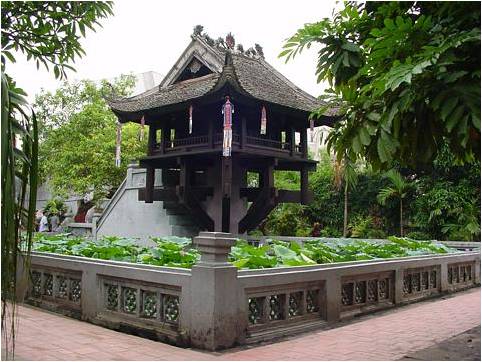
The One-Pillar Pagoda in the complex is an ancient one built in 1049 under the Ly Dynasty. There’s an interesting legend referring the construction of the pagoda, telling that King Ly Thanh Tong had this pagoda constructed in the shape of a blooming lotus, based upon his fairy dream, thanks to which he was given a baby boy.
6. Ho Chi Minh Museum
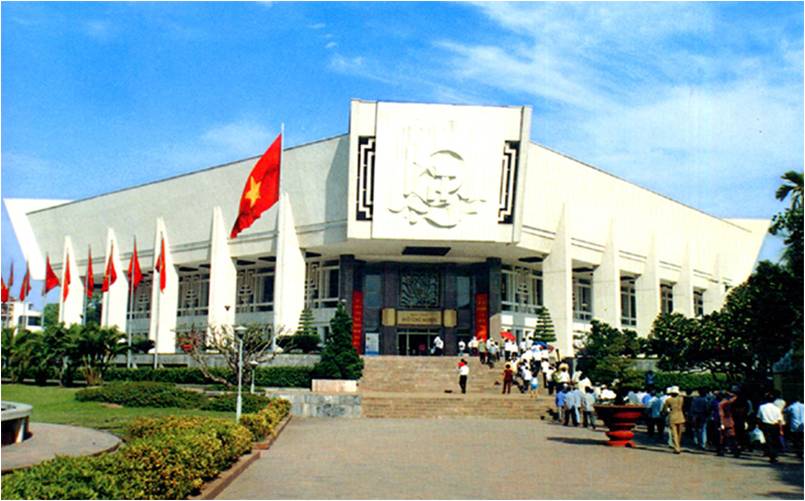
The museum is located on an area of the historical Ba Dinh square, the last spot in Ho Chi Minh complex. It was commenced in August 1985 and inaugurated on May 19th 1990 right on the birth centenary anniversary of President Ho Chi Minh.
The museum was built in the shape of a white lotus flower, which is nearly 20m high, including 3 floors. Coming here, tourists can share a part of Ho Chi Minh’s tough life.
In his whole life, Uncle Ho tried his best to find a new way for freedom of Vietnamese people, to build a Democratic Republic country so that Vietnamese people can live in a free, happy and independent society. I always remind myself to study harder so that I can develop our society in the future, to be a good citizen and to finish everything that Uncle Ho and the old generation couldn't do.
A TRIP BACK TO HO CHI MINH COMPLEX, AN ETHEREAL LOTUS
While the information technology is developing rapidly everyday, there are the majority of Vietnamese people, who are only focused on learning from other foreign countries but forget all the history and the traditions of Vietnam. In order to give students a change to understand more about Vietnamese history, our school management decided to hold a field trip for students.
During the trip, even till the last moment, I still remembered what I knew and learned there, at Ho Chi Minh Complex - one of the most tourist attractions in Hanoi. It brought me many emotions and I even cried.. Ho Chi Minh Complex consists of Ba Dinh Square, Ho Chi Minh's Mausoleum, Presidential Palace, Ho Chi Minh's house on stilts, One-Pillar Pagoda and Ho Chi Minh Museum.
1. Ba Dinh Square
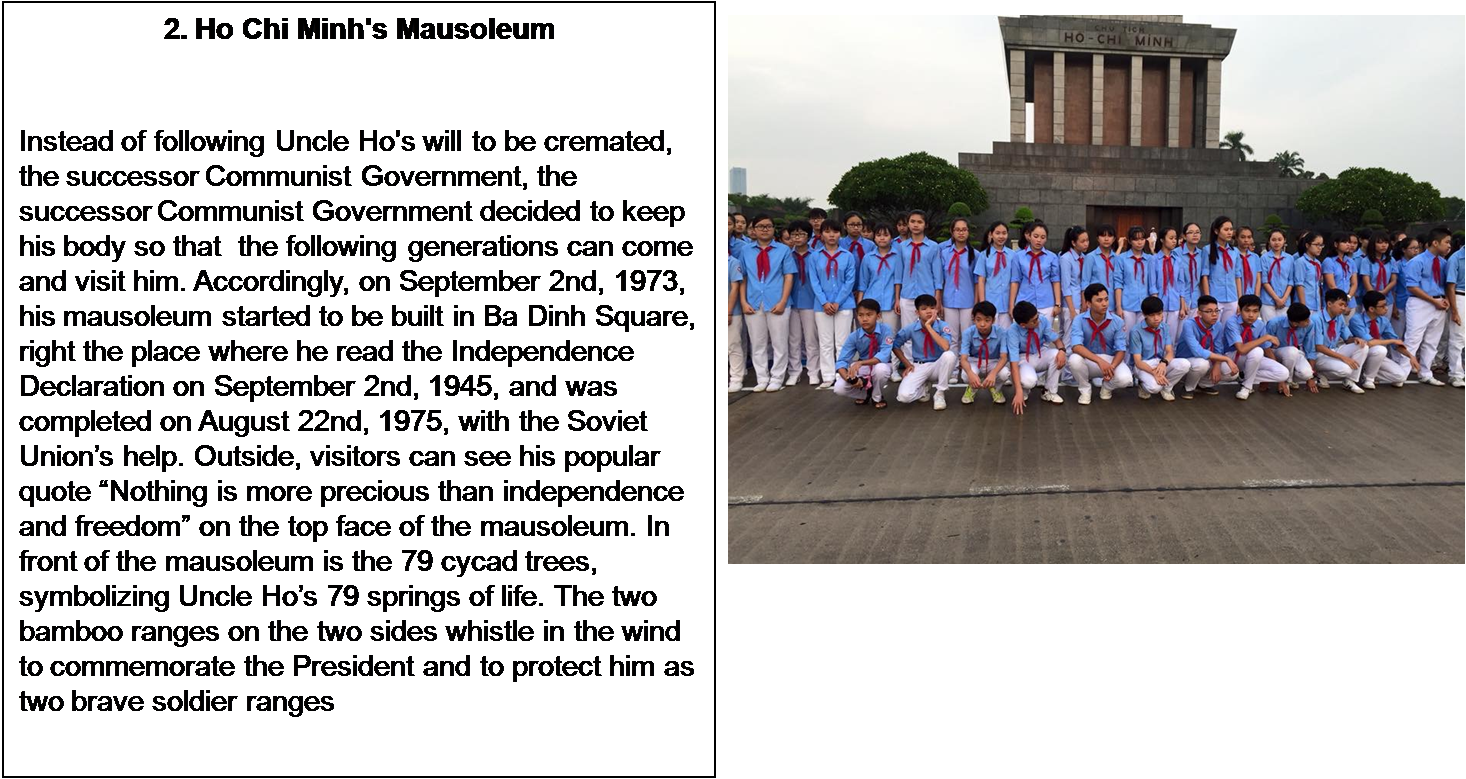
During the trip, even till the last moment, I still remembered what I knew and learned there, at Ho Chi Minh Complex - one of the most tourist attractions in Hanoi. It brought me many emotions and I even cried.. Ho Chi Minh Complex consists of Ba Dinh Square, Ho Chi Minh's Mausoleum, Presidential Palace, Ho Chi Minh's house on stilts, One-Pillar Pagoda and Ho Chi Minh Museum.
1. Ba Dinh Square
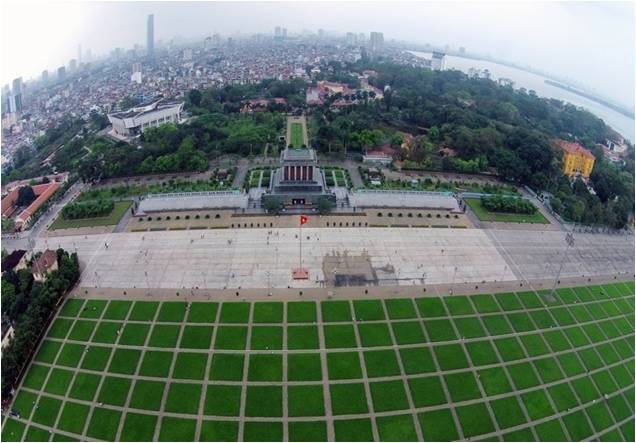 | Viewing from a height of 200 meters, Ba Dinh square looks like a huge and green chessboard which is 320 meters long, 100 meters wide and includes totally 240 square pieces of grass. In the middle there is a 25m high flagpole. Always, at 6 o'clock (in the summer) or at 6.30 a.m (in the winter), a significant flag-hoisting is started. Everybody, who does morning exercises around as well as walking, riding bicycles or driving ..., stops all the activities immediately, stands to show respect to Uncle Ho, the National Liberation Hero and all the soldiers who fought and died for the Democratic Republic of Vietnam. |
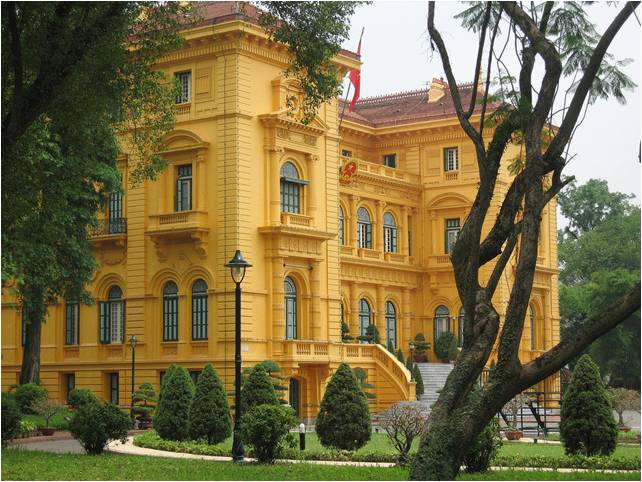
From the entrance of the complex, after walking a few steps, visitors will pass by the Presidential Palace, right next to the mausoleum. From 1901-1906, the palace was built by the French colonialists, as a palace of the General Indochina Governor. It has a special typical French structure and architecture, painted in luxury yellow. Since 1954, the Vietnamese Government took over this Palace to house the President. Yet, he refused, thus it has been used as the Presidential Palace for high-ranking level diplomatic meetings since then.
4. Ho Chi Minh's House on stilts
4. Ho Chi Minh's House on stilts
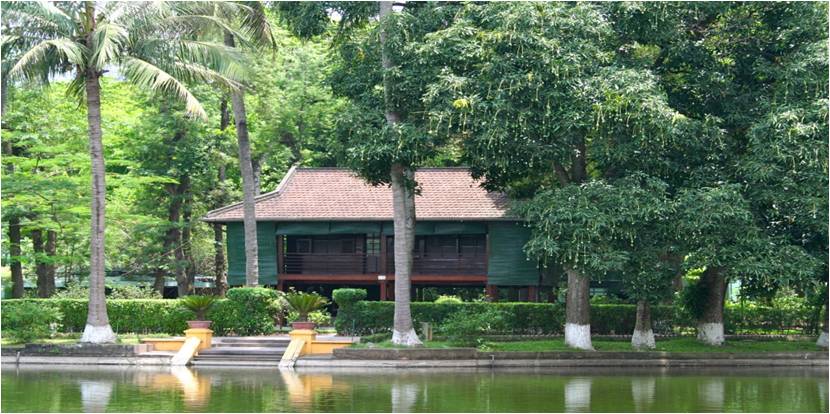
After refusing to live in the Presidential Palace, Uncle Ho lived in a small house nearby. The Government had a simple and nature-oriented environment constructed for him to live and work. Walking around, visitors can feel his simple and pure lifestyle in an wooden tiled house on stilt, surrounded by a gardens full of fruit trees and a peaceful fishpond. Especially, when you stand by the fishpond, if you clap your hands, all the fish in the pond will immediately go up to the surface, because that is what Uncle Ho always did when he was still alive, fed the fish every time when he was free.
The beloved President lived here from 1958 until he passed away.5. One-Pillar Pagoda
The One-Pillar Pagoda in the complex is an ancient one built in 1049 under the Ly Dynasty. There’s an interesting legend referring the construction of the pagoda, telling that King Ly Thanh Tong had this pagoda constructed in the shape of a blooming lotus, based upon his fairy dream, thanks to which he was given a baby boy.
6. Ho Chi Minh Museum
The museum is located on an area of the historical Ba Dinh square, the last spot in Ho Chi Minh complex. It was commenced in August 1985 and inaugurated on May 19th 1990 right on the birth centenary anniversary of President Ho Chi Minh.
The museum was built in the shape of a white lotus flower, which is nearly 20m high, including 3 floors. Coming here, tourists can share a part of Ho Chi Minh’s tough life.
In his whole life, Uncle Ho tried his best to find a new way for freedom of Vietnamese people, to build a Democratic Republic country so that Vietnamese people can live in a free, happy and independent society. I always remind myself to study harder so that I can develop our society in the future, to be a good citizen and to finish everything that Uncle Ho and the old generation couldn't do.
Nguồn tin: Trường THCS Lê Quý Đôn TP Lào Cai
 Xem phản hồi
 Gửi phản hồi
-
 NGƯỜI THẮP LỬA
-
 BÀI DỰ THI: “TẤM GƯƠNG NHÀ GIÁO VIỆT NAM” NĂM 2017 CÔ GIÁO TRẺ - SÁNG TẠO, TÀI NĂNG
-
 KẾ HOẠCH PHÁT TRIỂN CHIẾN LƯỢC GIAI ĐOẠN 2016 – 2020
-
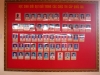 HỌC SINH GIỎI ĐẠT GIẢI TRONG CÁC CUỘC THI QUỐC GIA
-
 KẾ HOẠCH PHÁT TRIỂN CHIẾN LƯỢC TRƯỜNG THCS LÊ QUÝ ĐÔN GIAI ĐOẠN 2013 – 2015
-
 LOGO - TẦM NHÌN, SỨ MỆNH VÀ GIÁ TRỊ CỦA TRƯỜNG THCS LÊ QUÝ ĐÔN
-
 TÔ THÊM NHỮNG DẤU SON
-
 PHÁT ĐỘNG “CUỘC THI THUYẾT MINH LOGO NHÀ TRƯỜNG”
-
 CÓ MỘT GIỜ NGỮ VĂN NHƯ THẾ
-
 NGƯỜI NỮ HIỆU TRƯỞNG ĐẦU TIÊN - LUÔN NĂNG ĐỘNG SÁNG TẠO
-
 TẤM GƯƠNG VỀ NGƯỜI PHỤ NỮ VIỆT NAM HIỆN ĐẠI
-
 NGƯỜI CÁN BỘ QUẢN LÍ ÂM THẦM, LẶNG LẼ CỐNG HIẾN
-
 CÔ GIÁO TRẺ, SAY MÊ VỚI SỰ NGHIỆP TRỒNG NGƯỜI
-
 LỊCH SỬ XÂY DỰNG VÀ PHÁT TRIỂN TRƯỜNG THCS LÊ QUÝ ĐÔN
MENU
TIN MỚI



GIAO LƯU VĂN HOÁ "VIỆT - MỸ"






THỐNG KÊ TRUY CẬP
 Đang truy cập :
45
Đang truy cập :
45
 Hôm nay :
4435
Hôm nay :
4435
 Tháng hiện tại
: 91775
Tháng hiện tại
: 91775
 Tổng lượt truy cập : 5893403
Cuộc thi Nắng hát - trường THCS Lê Quý Đôn 2014
MÀN ĐỒNG DIỄN 20/11/2012
SỰ ĐỒNG LÒNG CỦA PHỤ NỮ
•CHUNG KẾT LẬP TRÌNH ALICE TOÀN QUỐC 2015
Designed by Mai Thị Hạnh Nguyên
Email: quyetchien09@gmail.com
Phone: 01688471512 - Address: THCS Lê Quý Đôn
Email: quyetchien09@gmail.com
Phone: 01688471512 - Address: THCS Lê Quý Đôn
-
Valid


-
LAO CAI EDUCATION -
Xem bản: Desktop | Mobile